Abstract
This study assessed the healthcare waste management (HCWM) infrastructure at Kambia Government Hospital (KGH), Sierra Leone. We evaluated various aspects of HCWM, including waste segregation, storage, collection, transportation, and disposal. Our findings revealed critical deficiencies, such as inadequate storage facilities, insufficient waste bins, and a lack of dedicated transportation systems. These shortcomings pose significant risks to healthcare workers, the general public, and the environment, including the potential for the spread of infectious diseases and contamination of the environment. To improve HCWM practices at KGH, we recommend implementing several key strategies. These include investing in adequate storage facilities, providing appropriate waste bins, establishing a dedicated waste transportation system, and conducting comprehensive staff training on HCWM protocols. Regular training sessions should cover topics such as waste classification, segregation, storage, collection, transportation, and disposal techniques. By empowering healthcare workers with the necessary knowledge and skills, we can significantly enhance HCWM practices at KGH. Furthermore, it is crucial to establish a robust system for monitoring and evaluating the effectiveness of HCWM interventions. Regular inspections of storage areas, waste bins, and transportation vehicles can help identify and address potential issues. By implementing these recommendations, KGH can improve its HCWM practices and contribute to a healthier and safer environment for its community. Effective HCWM is essential to protect public health and the environment. Poor management of healthcare waste can lead to the spread of infectious diseases, contamination of water sources, and exposure to hazardous chemicals. By addressing the identified deficiencies and implementing best practices, KGH can significantly improve its HCWM performance and reduce the associated risks.
Keywords
Healthcare Waste Management, Infrastructure, Colour Coding, Infectious
1. Introduction
Healthcare waste (HCW) poses significant threats to public health and the environment if not managed properly
| [26] | WHO (2014). Safe management of wastes from health-care activities. WHO Press, Geneva, 2014. |
[26]
. A well-functioning HCW infrastructure is crucial for safe waste handling practices across all stages, from generation to the point of care to final disposal
| [11] | Lwanga, S. H., Nyenzi, B. S., Luggya, A., & Vrijens, M. (2018). Medical waste management in low- and middle-income countries: A review. Waste Management, 74, 468-479. |
| [8] | Gordon JG, Rein Hardt PA, Denys GA (2004): Medical waste management. In: Mayhall CG (ed). Hospital epidemiology and infection control, (3rd). Lippincott Williams and Wilkins publication. Pages: 1773-85. |
[11, 8]
.
The risks associated with inadequate medical waste management are multifaceted
| [10] | Laboratory diagnosis, biosafety and quality control. National institute of communicable diseases and national AIDS control organization, Delhi. Pages 26-41. |
| [14] | Occupational Safety and Health Administration (OSHA, 2021). |
| [15] | Rao SK, Ranyal RK, Bhatia SS, Sharma VR (2004): Biomedical waste management: An infrastructural survey of hospitals, MJAFI, Vol. 60, (4). |
| [16] | Recycling in Healthcare (2018). Sustainable Practices in Hospitals. |
[10, 14-16]
. Healthcare workers are particularly vulnerable to exposure to pathogens through improper handling.
| [12] | Microwave Technology for Waste Treatment (2021). Innovative Solutions for Hospital Waste. |
| [20] | Silva CE, Hoppe AE, Ravanello MM, Mello N. Medical wastes management in the south of Brazil. Waste Manag. 2005; 25(6): 600-5. |
| [21] | Skad, M., Jedynak, M., Marchewka, A., & Morysińska, M. (2018). Medical waste Management A review of legal regulations and disposal methods. Journal of Environmental Management, 223, 974-982. |
| [22] | UNEP (United Nations Environment Programme) (2018). Guidelines for the environmentally sound management of biomedical waste. [ https://digitallibrary.un.org/record/475506?ln=en](https://digitallibrary.un.org/record/475506?ln=en ). |
| [23] | Veda, H., Kulkarni, R. S., Ajantha, G. S. (2007) Biomedical Waste Management: A Review, Journal of oral and maxillo facial pathology. |
[12, 20-23]
Inadequate medical waste management can lead to the increase in risk of healthcare-associated infections (HCAIs)
| [11] | Lwanga, S. H., Nyenzi, B. S., Luggya, A., & Vrijens, M. (2018). Medical waste management in low- and middle-income countries: A review. Waste Management, 74, 468-479. |
[11]
. Furthermore, inappropriate disposal practices, such as incineration without proper controls or open dumping, can lead to air and soil contamination with harmful toxins and pathogens, posing a threat to public health and ecological systems.
| [5] | Environmental Protection Agency (EPA) - Medical Waste, 2020. EPA Medical Waste. |
| [21] | Skad, M., Jedynak, M., Marchewka, A., & Morysińska, M. (2018). Medical waste Management A review of legal regulations and disposal methods. Journal of Environmental Management, 223, 974-982. |
| [22] | UNEP (United Nations Environment Programme) (2018). Guidelines for the environmentally sound management of biomedical waste. [ https://digitallibrary.un.org/record/475506?ln=en](https://digitallibrary.un.org/record/475506?ln=en ). |
[5, 21, 22]
Medical waste management practices are essential for mitigating these risks and ensuring a safe healthcare environment
| [6] | Environmental Management (2023): This review provides a detailed analysis of the composition and sources of general waste in hospitals. |
| [3] | Ethical and Environmental Implications of Pathological Waste Disposal," Bioethics Journal (2022): Explores the ethical and environmental impacts of pathological waste disposal. |
[6, 3]
. The World Health Organization (WHO) and the United Nations Environment Programme (UNEP) have established guidelines for the environmentally sound management of medical waste
. These guidelines emphasize the importance of the following; Waste Segregation: Separating different waste types at the point of generation to minimize contamination and facilitate appropriate treatment
| [24] | World Health Organization (WHO) - Healthcare Waste Management, 2018. WHO Healthcare Waste Factsheet. |
| [25] | Waste Management Software (2019). Tracking and Reporting for Healthcare Facilities. |
[24, 25]
. Safe Storage and Transportation: Utilizing designated containers and proper transportation protocols to prevent accidents and exposure
| [24] | World Health Organization (WHO) - Healthcare Waste Management, 2018. WHO Healthcare Waste Factsheet. |
| [25] | Waste Management Software (2019). Tracking and Reporting for Healthcare Facilities. |
| [17] | Reprocessing of Medical Devices (2020). Cost Savings and Waste Reduction. |
[24, 25, 17]
. This study aimed to evaluate the adequacy and functionality of the HCW infrastructure at KGH, a government-run hospital in Sierra Leone. The Kambia Government Hospital is situated in the Kambia Town which is the administrative center of the Kambia District, located in the Northern Province of Sierra Leone. Healthcare services in Kambia Town include a government hospital and several clinics. The healthcare system faces challenges such as limited medical supplies, inadequate staffing, and infrastructure constraints
| [18] | Staff Training Programs in Waste Management (2021). Educating Healthcare Workers for Safety and Compliance. |
[18]
. There are ongoing efforts to improve healthcare services, particularly in maternal and child health.
2. Materials and Methods
2.1. Description of the Study Area
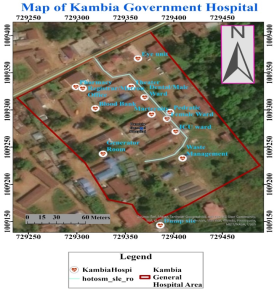
Kambia Town is the headquarters town of the Kambia District, positioned in the Northern Province of Sierra Leone. It is situated near the border with Guinea, making it a significant center for cross-border trade and cultural exchange. Kambia Town is home to a large population that includes various tribes such as the Temne, Susu, and Limba. The town has a blend of urban and rural characteristics, with many inhabitants engaged in agriculture, trade, and small-scale businesses. The economy of Kambia Town is primarily agricultural, with rice farming being the foremost agricultural activity. Other crops including cassava, groundnuts, and palm oil are also farmed in Kambia. The town's proximity to the border facilitates trade, and many residents are involved in marketable activities, including the procurement and selling of goods such as textiles, electronics, and foodstuffs. Livestock farming is also significant in the area.
Kambia Town has basic infrastructure, including schools, healthcare facilities, and markets. However, the town faces challenges with road conditions, electricity supply, and access to clean water. The main road linking Kambia to other parts of Sierra Leone and Guinea is crucial for transportation and trade but often requires maintenance. Education in Kambia Town is served by several primary and secondary schools, but resources are limited. Efforts to improve educational infrastructure and access are on-going, with support from government and non-governmental organizations.
Kambia Town is characterized by a rich cultural heritage with a blend of traditional customs and modern influences. Festivals, music, dance, and traditional ceremonies play an important role in the community. The town's social fabric is strengthened by communal activities and a strong sense of identity among its residents.
Figure 1. Map Showing the Study Area.
2.2. Data Collection Procedure
A cross-sectional study was conducted at KGH from 6th July 2024 to 20
th July 2024. Data collection methods included both primary and secondary sources of data were used by different approaches. For the primary data, collection of data involves the extraction of information from the field investigation to get first-hand information. Information was obtained through an inventory sheet and direct observation. The study involved a comprehensive assessment of the hospital’s physical assets, including the number and distribution of beds, the condition of functional and non-functional buildings, and the general infrastructure. Data were collected through direct observation and records provided by hospital administration. A comparative analysis was conducted to assess the adequacy of KGH’s bed capacity against the needs of the local population. Patient data ward occupancy rates and infrastructure conditions were evaluated to determine the hospital’s capability to handle patient load. The study involved an audit of the waste management practices at KGH, focusing on the use of colour-coded bins, waste segregation practices, and the state of waste storage facilities. An evaluation of the hospital’s waste management infrastructure, including the availability and condition of waste transportation and disposal facilities, was conducted. An analysis of the hospital’s staffing structure was performed, focusing on the number, roles, and qualifications of personnel. Data were gathered through staff records and interviews with hospital management. A detailed inventory of medical equipment was conducted to assess functionality and identify any operational issues. For secondary source of data collection, information was obtained from relevant literatures,
| [1] | Chinese Ministry of Health - Healthcare Waste Management in China, 2018. |
| [26] | WHO (2014). Safe management of wastes from health-care activities. WHO Press, Geneva, 2014. |
| [22] | UNEP (United Nations Environment Programme) (2018). Guidelines for the environmentally sound management of biomedical waste. [ https://digitallibrary.un.org/record/475506?ln=en](https://digitallibrary.un.org/record/475506?ln=en ). |
| [19] | Singh et al., 2023: Hospital Waste Management: A Review" by Singh et al., Journal of Environmental Management (2023). |
| [11] | Lwanga, S. H., Nyenzi, B. S., Luggya, A., & Vrijens, M. (2018). Medical waste management in low- and middle-income countries: A review. Waste Management, 74, 468-479. |
[1, 26, 22, 19, 11].
3. Results and Discussions
3.1. Fixed Assets at the Kambia Government Hospital (KGH)
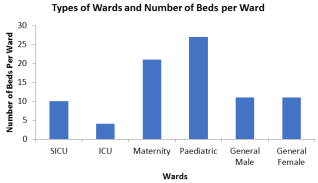
KGH comprises 22 functional buildings, 6 of which house wards. Each ward building has a single ward. The hospital has a total bed capacity of 94, distributed across departments: SICU (10), ICU (4), Maternity (21), Paediatric (27), Male Ward (11), and Female Ward (11). Six additional buildings serve as staff quarters. The Paediatric Ward has the highest number of beds followed by Maternity Ward, General Male ward, General Female Ward, SICU Ward, and ICU Ward. Kambia Government Hospital (KGH) is equipped with a significant number of functional buildings, but the capacity and functionality of these assets are critically limited. With only 94 beds distributed across various wards, including the Paediatric Ward with the highest capacity, KGH's resources fall short when compared to the needs of the town and district. This insufficiency becomes evident as patient numbers sometimes exceed available bed capacity, potentially compromising patient care and service delivery.
Figure 2. Types of Wards and Number of Beds at each Ward.
3.2. Colour Coding of Waste Bins
Colour coding helps prevent cross-contamination by ensuring that different types of waste are disposed of correctly
| [2] | Department of Health, South Africa. National Health Care Waste Management Policy. Pretoria: Department of Health, 2010. |
[2]
. For example, clinical waste, which may be infectious, is separated from general waste.
It reduces the risk of injury or infection to healthcare workers and patients by clearly identifying hazardous waste
| [10] | Laboratory diagnosis, biosafety and quality control. National institute of communicable diseases and national AIDS control organization, Delhi. Pages 26-41. |
[10]
. This way, staff can handle and dispose of waste safely. Hospitals must comply with strict waste management regulations
| [7] | Goyal, P., & Singh, A. K. (2016). Healthcare waste management in India: A review. Waste Management, 57, 21-34. |
[7]
. Colour coding helps ensure that waste is segregated and disposed of according to legal requirements
| [4] | EPA (2016). Hospital Medical Waste Incinerators. |
| [8] | Gordon JG, Rein Hardt PA, Denys GA (2004): Medical waste management. In: Mayhall CG (ed). Hospital epidemiology and infection control, (3rd). Lippincott Williams and Wilkins publication. Pages: 1773-85. |
[4, 8]
. Environmental Responsibility: Proper segregation of waste through colour coding ensures that recyclable materials are separated from non-recyclable ones, promoting environmental sustainability
| [13] | Ministry of Health and Family Welfare, Bangladesh. National Health Care Waste Management Guidelines. Dhaka: Ministry of Health and Family Welfare, 2017. |
| [17] | Reprocessing of Medical Devices (2020). Cost Savings and Waste Reduction. |
[13, 17]
. It streamlines the waste disposal process, making it easier for staff to quickly identify and dispose of waste correctly, saving time and reducing errors
| [9] | HCWM (2020). Best Practices in Healthcare Waste Management. |
[9]
.
3.3. Waste Bins
The KGH utilizes bins for waste collection with three different colour codes. At Ward-Level Segregation, each ward has bins for clinical waste (yellow), general waste (black), and sharps (red). Additional general waste bins are distributed throughout the hospital compound.
Table 1. Bins Colour Codes.
Colour | Types of Waste Stored |
Yellow | Infectious |
Red | Sharps |
Black | General |
A functional storage facility is available for HCW. Unfortunately, the hospital lacks a dedicated vehicle for waste transportation. KGH has a non-functional incinerator. This means the waste generated have to be disposed elsewhere. The waste disposal is done by the Kambia Council. The lack of adequate facilities and infrastructure impacts overall hospital performance. The observation aligns with findings from Singh and Rehman (2007)
| [19] | Singh et al., 2023: Hospital Waste Management: A Review" by Singh et al., Journal of Environmental Management (2023). |
[19]
, which highlighted infrastructure limitations in developing countries that lead to challenges in waste management and patient care
| [10] | Laboratory diagnosis, biosafety and quality control. National institute of communicable diseases and national AIDS control organization, Delhi. Pages 26-41. |
| [12] | Microwave Technology for Waste Treatment (2021). Innovative Solutions for Hospital Waste. |
[10, 12]
. Such constraints likely affect both the quality of care and the hospital's ability to manage waste effectively, as insufficient facilities strain the hospital’s capacity to handle increasing patient numbers
| [16] | Recycling in Healthcare (2018). Sustainable Practices in Hospitals. |
| [18] | Staff Training Programs in Waste Management (2021). Educating Healthcare Workers for Safety and Compliance. |
[16, 18]
. The mortuary is currently non-operational, with a single non-functional refrigerator.
3.4. Human Resources at KGH
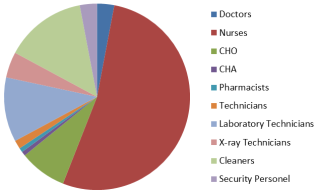
As of the study period, KGH has four medical doctors, with three pursuing further education. The hospital employs 71 nurses, with approximately half being volunteers. KGH employs staff across various departments, including pharmacists (1), technicians (2), laboratory technicians (15, half volunteers), a dentist (1), a nutritionist (1), cooks (6), cleaners (19, half volunteers), X-ray technicians (6), security personnel (4), and medical equipment technicians (3). Notably, KGH lacks dedicated public health officers for HCWM oversight. Community Health Officers (CHOs): The hospital has 11 CHOs, who may play a role in HCWM education and community outreach. Community Health Assistants (CHAs). One CHA is present at KGH. The staffing levels at KGH are indicative of both strengths and weaknesses. While the hospital has a reasonable number of nurses and other support staff, a substantial portion of these positions are filled by volunteers. The absence of dedicated public health officers for health care waste management (HCWM) oversight further underscores a critical gap in effective waste management and overall health services administration.
Figure 3. Human Resources at KGH.
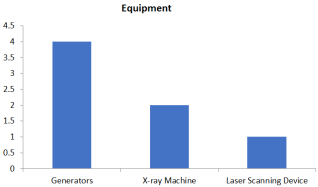
Figure 4. Equipment at KGH.
3.5. Equipment at KGH
Four generators are available, with only half functioning. Two X-ray machines are present but non-functional. One faulty laser scanning device was identified. The presence of non-functional equipment, such as X-ray machines and a faulty laser scanning device, indicates that KGH faces significant challenges in maintaining operational medical technology. This can limit diagnostic capabilities and overall service efficiency.
4. Conclusions
The findings reveal limitations in the HCW infrastructure at KGH. While the hospital utilizes color-coded bins for waste segregation at the point of generation, the lack of dedicated transportation and a non-functional incinerator pose significant challenges for safe and efficient HCW management. The reliance on volunteers for both nursing and cleaning staff might lead to inconsistencies in waste handling practices due to potential lack of training or experience. Additionally, the absence of dedicated public health officers hinders effective oversight and implementation of HCWM policies.
The Kambia Government Hospital is facing significant challenges due to inadequate bed capacity, non-functional facilities, and equipment. These deficiencies limit the hospital's ability to provide adequate care and manage patient volumes effectively. Despite implementing a colour-coded waste segregation system, KGH’s waste management practices are hindered by the lack of a dedicated vehicle for waste transportation and a non-functional incinerator. This highlights a need for improved infrastructure to support waste management practices. The non-operational mortuary is a critical issue that affects the hospital’s capacity to handle deceased patients properly. The reliance on volunteers and the lack of dedicated public health officers for HCWM oversight represent significant gaps in the hospital's operational capacity and waste management practices. Non-functional and faulty medical equipment restricts the hospital’s diagnostic and treatment capabilities, further impacting the quality of care. Addressing these issues will require targeted investments in infrastructure, equipment, and human resources, along with improved waste management practices to enhance the overall functionality and service delivery at KGH. The general challenges faced by healthcare facilities in low-resource settings, such as inadequate infrastructure, staffing shortages, and equipment deficiencies, are well-documented in the literature. References like Singh and Rehman (2007)
| [19] | Singh et al., 2023: Hospital Waste Management: A Review" by Singh et al., Journal of Environmental Management (2023). |
[19]
and Lwanga et al. (2018)
| [11] | Lwanga, S. H., Nyenzi, B. S., Luggya, A., & Vrijens, M. (2018). Medical waste management in low- and middle-income countries: A review. Waste Management, 74, 468-479. |
[11]
discuss these challenges in detail and highlight their impact on patient care and healthcare worker safety.
5. Recommendations
To effectively address the identified challenges and improve healthcare waste management (HCWM) practices at KGH and similar facilities, a comprehensive approach is essential. This approach should involve infrastructure development, human resource capacity building, and policy and regulatory framework enhancements.
Firstly, significant investments in infrastructure are necessary. This includes procuring a dedicated vehicle for safe and timely transportation of HCW to appropriate disposal sites. Additionally, repairing or replacing the non-functional incinerator is crucial for proper treatment of infectious waste. Adequate color-coded bins and storage areas should be provided for effective waste segregation at the point of generation. Furthermore, upgrading or constructing a functional mortuary is essential for handling deceased patients with dignity and respect.
Secondly, human resource capacity building is a critical component. Comprehensive training programs should be implemented to educate healthcare workers on proper HCWM practices, and the appointment of dedicated public health officers to oversee and implement HCWM policies and procedures is also very essential.
Thirdly, a robust policy and regulatory framework is necessary. HCWM practices should align with international guidelines, such as those provided by the World Health Organization
| [26] | WHO (2014). Safe management of wastes from health-care activities. WHO Press, Geneva, 2014. |
[26]
. Regular monitoring and evaluation systems should be implemented to assess the effectiveness of HCWM practices and identify areas for improvement. Collaboration with relevant regulatory authorities is crucial to ensure compliance with HCWM regulations and standards.
Finally, learning from successful case studies in other low-resource countries can provide valuable insights. For instance, India has implemented a comprehensive HCWM program that includes training, capacity building, and infrastructure development
| [7] | Goyal, P., & Singh, A. K. (2016). Healthcare waste management in India: A review. Waste Management, 57, 21-34. |
[7]
, South Africa has focused on public-private partnerships and community engagement to improve HCWM
| [2] | Department of Health, South Africa. National Health Care Waste Management Policy. Pretoria: Department of Health, 2010. |
[2]
, and Bangladesh has implemented a national HCWM strategy that emphasizes the role of healthcare workers in proper waste management
| [13] | Ministry of Health and Family Welfare, Bangladesh. National Health Care Waste Management Guidelines. Dhaka: Ministry of Health and Family Welfare, 2017. |
[13]
.
Abbreviations
BWM | Biomedical Waste Management |
CHA | Community Health Assistant |
CHO | Community Health Officer |
EPA | Environmental Protection Agency |
HCAIs | Healthcare-associated Infections |
HCWM | Healthcare Waste Management |
IPC | Infection Prevention and Control |
ICU | Intensive Care Unit |
KGH | Kambia Government Hospital |
LMICs | Low & Middle-Income Countries |
NHS | National Health Service |
PPE | Personal Protective Equipment |
UNDP | United Nation Environmental Programme |
WHO | World Health Organisation |
SICU | Surgical Intensive Care Unit |
Author Contributions
Abubakarr Mohamed Kamara: Conceptualization, Data curation, Formal Analysis, Funding acquisition, Investigation, Methodology, Project administration, Resources, Software, Validation, Visualization, Writing – original draft, Writing – review & editing
Gibrilla Thullah: Conceptualization, Data curation, Formal Analysis, Investigation, Methodology, Project administration, Resources, Software, Validation, Visualization, Writing – original draft, Writing – review & editing
Hamidu David Mansaray: Conceptualization, Data curation, Formal Analysis, Investigation, Methodology, Project administration, Resources, Software, Validation, Visualization, Writing – original draft, Writing – review & editing
Yahaya Kudush Kawa: Conceptualization, Data curation, Formal Analysis, Investigation, Methodology, Project administration, Resources, Software, Supervision, Validation, Visualization, Writing – original draft, Writing – review & editing
Conflicts of Interest
The authors declare no conflicts of interest.
References
| [1] |
Chinese Ministry of Health - Healthcare Waste Management in China, 2018.
|
| [2] |
Department of Health, South Africa. National Health Care Waste Management Policy. Pretoria: Department of Health, 2010.
|
| [3] |
Ethical and Environmental Implications of Pathological Waste Disposal," Bioethics Journal (2022): Explores the ethical and environmental impacts of pathological waste disposal.
|
| [4] |
EPA (2016). Hospital Medical Waste Incinerators.
|
| [5] |
Environmental Protection Agency (EPA) - Medical Waste, 2020. EPA Medical Waste.
|
| [6] |
Environmental Management (2023): This review provides a detailed analysis of the composition and sources of general waste in hospitals.
|
| [7] |
Goyal, P., & Singh, A. K. (2016). Healthcare waste management in India: A review. Waste Management, 57, 21-34.
|
| [8] |
Gordon JG, Rein Hardt PA, Denys GA (2004): Medical waste management. In: Mayhall CG (ed). Hospital epidemiology and infection control, (3rd). Lippincott Williams and Wilkins publication. Pages: 1773-85.
|
| [9] |
HCWM (2020). Best Practices in Healthcare Waste Management.
|
| [10] |
Laboratory diagnosis, biosafety and quality control. National institute of communicable diseases and national AIDS control organization, Delhi. Pages 26-41.
|
| [11] |
Lwanga, S. H., Nyenzi, B. S., Luggya, A., & Vrijens, M. (2018). Medical waste management in low- and middle-income countries: A review. Waste Management, 74, 468-479.
|
| [12] |
Microwave Technology for Waste Treatment (2021). Innovative Solutions for Hospital Waste.
|
| [13] |
Ministry of Health and Family Welfare, Bangladesh. National Health Care Waste Management Guidelines. Dhaka: Ministry of Health and Family Welfare, 2017.
|
| [14] |
Occupational Safety and Health Administration (OSHA, 2021).
|
| [15] |
Rao SK, Ranyal RK, Bhatia SS, Sharma VR (2004): Biomedical waste management: An infrastructural survey of hospitals, MJAFI, Vol. 60, (4).
|
| [16] |
Recycling in Healthcare (2018). Sustainable Practices in Hospitals.
|
| [17] |
Reprocessing of Medical Devices (2020). Cost Savings and Waste Reduction.
|
| [18] |
Staff Training Programs in Waste Management (2021). Educating Healthcare Workers for Safety and Compliance.
|
| [19] |
Singh et al., 2023: Hospital Waste Management: A Review" by Singh et al., Journal of Environmental Management (2023).
|
| [20] |
Silva CE, Hoppe AE, Ravanello MM, Mello N. Medical wastes management in the south of Brazil. Waste Manag. 2005; 25(6): 600-5.
|
| [21] |
Skad, M., Jedynak, M., Marchewka, A., & Morysińska, M. (2018). Medical waste Management A review of legal regulations and disposal methods. Journal of Environmental Management, 223, 974-982.
|
| [22] |
UNEP (United Nations Environment Programme) (2018). Guidelines for the environmentally sound management of biomedical waste. [
https://digitallibrary.un.org/record/475506?ln=en](https://digitallibrary.un.org/record/475506?ln=en
).
|
| [23] |
Veda, H., Kulkarni, R. S., Ajantha, G. S. (2007) Biomedical Waste Management: A Review, Journal of oral and maxillo facial pathology.
|
| [24] |
World Health Organization (WHO) - Healthcare Waste Management, 2018. WHO Healthcare Waste Factsheet.
|
| [25] |
Waste Management Software (2019). Tracking and Reporting for Healthcare Facilities.
|
| [26] |
WHO (2014). Safe management of wastes from health-care activities. WHO Press, Geneva, 2014.
|
Cite This Article
-
APA Style
Kamara, A. M., Thullah, G., Mansaray, H. D., Kawa, Y. K. (2024). Assessment of the Healthcare Waste Infrastructure at Kambia Government Hospital, Sierra Leone. American Journal of Environmental Protection, 13(6), 186-191. https://doi.org/10.11648/j.ajep.20241306.12
 Copy
|
Copy
|
 Download
ACS Style
Kamara, A. M.; Thullah, G.; Mansaray, H. D.; Kawa, Y. K. Assessment of the Healthcare Waste Infrastructure at Kambia Government Hospital, Sierra Leone. Am. J. Environ. Prot. 2024, 13(6), 186-191. doi: 10.11648/j.ajep.20241306.12
Copy
|
Download
AMA Style
Kamara AM, Thullah G, Mansaray HD, Kawa YK. Assessment of the Healthcare Waste Infrastructure at Kambia Government Hospital, Sierra Leone. Am J Environ Prot. 2024;13(6):186-191. doi: 10.11648/j.ajep.20241306.12
Copy
|
Download
-
@article{10.11648/j.ajep.20241306.12,
  author = {Abubakarr Mohamed Kamara and Gibrilla Thullah and Hamidu David Mansaray and Yahaya Kudush Kawa},
  title = {Assessment of the Healthcare Waste Infrastructure at Kambia Government Hospital, Sierra Leone
},
  journal = {American Journal of Environmental Protection},
  volume = {13},
  number = {6},
  pages = {186-191},
  doi = {10.11648/j.ajep.20241306.12},
  url = {https://doi.org/10.11648/j.ajep.20241306.12},
  eprint = {https://article.sciencepublishinggroup.com/pdf/10.11648.j.ajep.20241306.12},
  abstract = {This study assessed the healthcare waste management (HCWM) infrastructure at Kambia Government Hospital (KGH), Sierra Leone. We evaluated various aspects of HCWM, including waste segregation, storage, collection, transportation, and disposal. Our findings revealed critical deficiencies, such as inadequate storage facilities, insufficient waste bins, and a lack of dedicated transportation systems. These shortcomings pose significant risks to healthcare workers, the general public, and the environment, including the potential for the spread of infectious diseases and contamination of the environment. To improve HCWM practices at KGH, we recommend implementing several key strategies. These include investing in adequate storage facilities, providing appropriate waste bins, establishing a dedicated waste transportation system, and conducting comprehensive staff training on HCWM protocols. Regular training sessions should cover topics such as waste classification, segregation, storage, collection, transportation, and disposal techniques. By empowering healthcare workers with the necessary knowledge and skills, we can significantly enhance HCWM practices at KGH. Furthermore, it is crucial to establish a robust system for monitoring and evaluating the effectiveness of HCWM interventions. Regular inspections of storage areas, waste bins, and transportation vehicles can help identify and address potential issues. By implementing these recommendations, KGH can improve its HCWM practices and contribute to a healthier and safer environment for its community. Effective HCWM is essential to protect public health and the environment. Poor management of healthcare waste can lead to the spread of infectious diseases, contamination of water sources, and exposure to hazardous chemicals. By addressing the identified deficiencies and implementing best practices, KGH can significantly improve its HCWM performance and reduce the associated risks.
},
 year = {2024}
}
Copy
|
Download
-
TY  - JOUR
T1  - Assessment of the Healthcare Waste Infrastructure at Kambia Government Hospital, Sierra Leone

AU  - Abubakarr Mohamed Kamara
AU  - Gibrilla Thullah
AU  - Hamidu David Mansaray
AU  - Yahaya Kudush Kawa
Y1  - 2024/11/26
PY  - 2024
N1  - https://doi.org/10.11648/j.ajep.20241306.12
DO  - 10.11648/j.ajep.20241306.12
T2  - American Journal of Environmental Protection
JF  - American Journal of Environmental Protection
JO  - American Journal of Environmental Protection
SP  - 186
EP  - 191
PB  - Science Publishing Group
SN  - 2328-5699
UR  - https://doi.org/10.11648/j.ajep.20241306.12
AB  - This study assessed the healthcare waste management (HCWM) infrastructure at Kambia Government Hospital (KGH), Sierra Leone. We evaluated various aspects of HCWM, including waste segregation, storage, collection, transportation, and disposal. Our findings revealed critical deficiencies, such as inadequate storage facilities, insufficient waste bins, and a lack of dedicated transportation systems. These shortcomings pose significant risks to healthcare workers, the general public, and the environment, including the potential for the spread of infectious diseases and contamination of the environment. To improve HCWM practices at KGH, we recommend implementing several key strategies. These include investing in adequate storage facilities, providing appropriate waste bins, establishing a dedicated waste transportation system, and conducting comprehensive staff training on HCWM protocols. Regular training sessions should cover topics such as waste classification, segregation, storage, collection, transportation, and disposal techniques. By empowering healthcare workers with the necessary knowledge and skills, we can significantly enhance HCWM practices at KGH. Furthermore, it is crucial to establish a robust system for monitoring and evaluating the effectiveness of HCWM interventions. Regular inspections of storage areas, waste bins, and transportation vehicles can help identify and address potential issues. By implementing these recommendations, KGH can improve its HCWM practices and contribute to a healthier and safer environment for its community. Effective HCWM is essential to protect public health and the environment. Poor management of healthcare waste can lead to the spread of infectious diseases, contamination of water sources, and exposure to hazardous chemicals. By addressing the identified deficiencies and implementing best practices, KGH can significantly improve its HCWM performance and reduce the associated risks.

VL  - 13
IS  - 6
ER  -
Copy
|
Download




 Share This Article
 Twitter
 Linked In
 Facebook