Research Article | | Peer-Reviewed

Deforestation Dynamics and Ecological Consequences in the Dry Dense Deciduous Forests of Belindo-Mahasoa (Bekily, Southern Madagascar)

Received: 17 December 2025     Accepted: 26 December 2025     Published: 31 January 2026
Views:       Downloads:
Abstract

The dry Dry deciduous forests in southern Madagascar are among the country’s most vulnerable ecosystems, increasingly threatened by expanding anthropogenic pressures., These forest formations are among the most heavily affected by deforestation, driven by agricultural expansion, charcoal production and timber extraction, leading to a continuous decline in forest cover. How have spatio-temporal deforestation dynamics between 2015 and 2025 altered forest cover, fragmentation, and ecological resilience in Belindo-Mahasoa, and what sustainable management responses are required to ensure long-term conservation efforts locally?. In the commune of Belindo-Mahasoa, located in the Bekily district, a spatio-temporal analysis of forest cover between 2015 and 2025 reveals a pronounced deforestation dynamic, marked by substantial reductions in wooded areas and increased landscape fragmentation. This pattern reflects a broader regional trend of rapid ecological degradation in southern Malagasy dry forests under increasing land-use pressures. Although small patches of vegetation recovery have emerged, largely linked to recent local restoration initiatives, their extent remains limited compared to the magnitude of forest loss. Overall, the findings underscore the urgent need to strengthen sustainable management strategies and restoration efforts to safeguard the essential ecological functions of these dry deciduous forests, whose resilience appears increasingly compromised. Thus, this article aims to provide recommendations to support conservation efforts and strengthen sustainable management strategies in order to safeguard the essential ecological functions of these dry deciduous forests.

Published in American Journal of Environmental Protection (Volume 15, Issue 1)
DOI 10.11648/j.ajep.20261501.14
Page(s) 30-38
Creative Commons

This is an Open Access article, distributed under the terms of the Creative Commons Attribution 4.0 International License (http://creativecommons.org/licenses/by/4.0/), which permits unrestricted use, distribution and reproduction in any medium or format, provided the original work is properly cited.

Copyright

Copyright © The Author(s), 2026. Published by Science Publishing Group

Keywords

Dry Deciduous Forests, Deforestation, Spatial Dynamics, Ecological Fragmentation, Southern Madagascar, Forest Restoration

1. Introduction
The dry dense deciduous forests of southern Madagascar represent essential ecosystems for biodiversity and local communities. At the national scale, they cover approximately 1,003,000 ha, representing nearly 8% of the national territory, while southern xerophytic forests extend over 1,444,000 ha. These vegetation formations in semi-arid zones undergo continuous annual degradation due to the combined effects of deforestation, extensive agropastoral practices, and climatic variability. According to the , even at that time, 23% of dry dense deciduous forests and 32% of xerophytic forests already showed advanced signs of degradation. Nevertheless, these ecosystems still harbor emblematic endemic fauna and flora of the Greater Southern region of Madagascar.
In the Bekily District, dry dense forests cover approximately 2,598 ha, concentrated in the northwestern part up to Belindo-Mahasoa, while xerophytic forests extend over 7,915 ha . These formations are complemented by savannas, which occupy 423,770 ha without woody elements and 83,319 ha with woody elements within the Bekily District . Dry dense forests and xerophytic thickets in the South exhibit an average density of 850 stems per hectare . Today, these formations are severely threatened by fuelwood harvesting, agricultural land conversion, pastoral transhumance, and recurrent droughts.
In the Belindo-Mahasoa municipality, deforestation is particularly alarming. Forest cover dynamics observed between 2015 and 2025 reveal a significant loss of forest area and increasing fragmentation, highlighting both the most affected zones and those that remain relatively stable. define deforestation as the long-term disappearance of forest cover resulting from agricultural practices or repeated resource exploitation, leading to the conversion of forested environments into other land-use types.
In response to these challenges, local participatory restoration initiatives have emerged, mobilizing traditional ecological knowledge and the active involvement of the fokonolona, with support from local NGOs such as Tany Meva and AIM. These actions aim to restore forest cover and strengthen the socio-ecological resilience of communities facing environmental degradation. This study presents and analyzes the dynamics of deforestation in Belindo-Mahasoa and examines local sustainable restoration strategies implemented to enhance community-based management and resilience of southern Madagascar’s dry forests.
2. Study Framework
2.1. Study Area
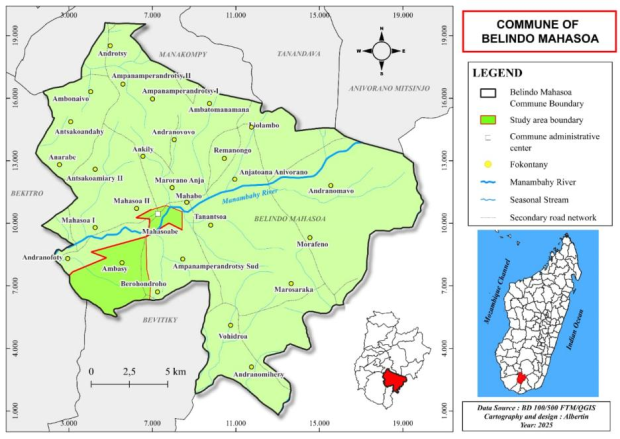
The study was conducted in the Belindo Mahasoa municipality (567 km²), located 35 km southeast of Bekily, in southern Madagascar. The rapidly growing local population from 16,241 inhabitants in 2018 to approximately 19,900 in 2022 according to Tany Meva (2022) exerts increasing pressure on forest resources through rising demand for fuelwood, construction materials, and agricultural land.
Figure 1. Belindo-Mahasoa municipality, Bekily District. Belindo-Mahasoa municipality, Bekily District.
Field investigations were carried out in two Fokontany (Ampasy and Mahasoa2) within the Belindo-Mahasoa municipality, identified as the main sites for community-led reforestation activities supported financially by the NGO Tany Meva and the association AIM between 2022 and 2024.
2.2. Vegetation Characteristics in the Study Area
The dry forests of the Bekily District are primarily composed of xerophytic formations characteristic of the Greater South of Madagascar. These include endemic or drought-adapted species such as Alluaudia procera (fantsiholitra), various Euphorbia species, Aloe, Kalanchoe, and Tamarindus indica (tamarind trees). These formations also comprise typical shrubs such as Commiphora, Phyllanthus, and Rhigozum. The savannas, on the other hand, are dominated by species such as Poupartia caffra (sakoa), Flacourtia indica (lamonty), and Celastrus linearis (tsingilofilo), which form an important component of the region’s landscape .
3. Methodology
3.1. Diachronic Analysis Using Satellite Remonte Sensing
For this study, we adopted a diachronic approach based on the analysis of satellite images acquired at multiple reference dates. This method allows for the measurement of spatio-temporal changes in forest cover in the Belindo-Mahasoa area. We used Landsat 8 OLI/TIRS images corresponding to three key periods (2015, 2020, and 2025). These data, characterized by a 30 m spatial resolution and regular revisit intervals, are particularly suitable for monitoring deforestation dynamics. They enable the identification of landscape transformations and the quantification of their evolution over a decade.
3.2. Data Processing and Analysis with QGIS
After performing radiometric and geometric corrections on the Landsat images, clouded and shadowed areas were removed to ensure data quality. We also calculated the Normalized Difference Vegetation Index (NDVI), which improves the distinction between forested areas and degraded or sparsely vegetated zones. A supervised classification using the Random Forest algorithm was then applied to identify the main land cover classes: dry dense forests, xerophytic forests, agricultural or pasture areas, and degraded zones. To assess the accuracy of this classification, field control points were used. These data were employed to construct a confusion matrix, allowing the measurement of classification precision and identification of potential errors.
Forest loss, gain, and stability maps between 2015 and 2025 were subsequently produced. The annual deforestation rate was calculated by relating the change in forest area to the number of years, enabling the identification of the most affected zones. All spatial analyses were conducted using QGIS for mapping, while R and Python were used for data processing and execution of the Random Forest model.
3.3. Field Survey
Field surveys were conducted to complement the satellite analysis and gain a deeper understanding of local drivers of deforestation. Several participatory approaches were employed, including focus groups, direct observations, and semi-structured interviews. Discussions were held with members of the fokonolona, local nursery operators, the head of the Bekily Water and Forests cantonment, personnel from partner NGOs, and community leaders involved in forest restoration activities. These interviews allowed the identification of local practices, pressures on forest resources, and existing management or reforestation initiatives.
4. Results and Discussion
This section presents and analyzes the results obtained on the status of dry forests in Belindo-Mahasoa, the drivers of degradation, and the community-based participatory restoration strategies implemented by the local population.
4.1. Deforestation Dynamics in Belindo-Mahasoa, Bekily
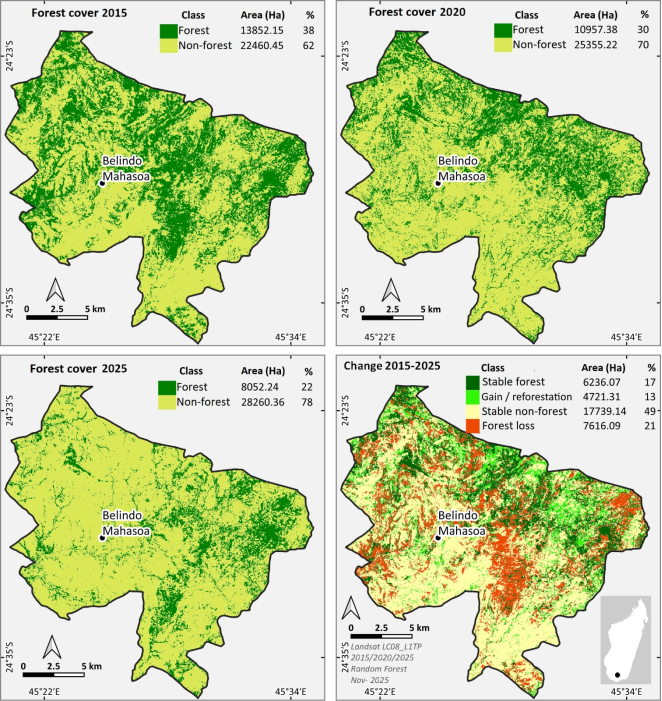
The diachronic analysis of forest cover in Belindo-Mahasoa between 2015 and 2025 reveals a clear trend of continuous forest area decline and a significant expansion of non-forested areas. Maps produced from Landsat images (2015, 2020, and 2025) show a progressive and marked reduction of forest cover, accompanied by intensified fragmentation processes. The change classes over the 2015–2025 period highlight hotspots of forest loss, particularly concentrated in the southern and southeastern parts of the municipality, while stable forest areas decrease and become isolated fragments. This dynamic reflects the cumulative impact of anthropogenic pressures, notably extensive agricultural practices, fuelwood collection, and land conversion, exacerbated by the recurrent droughts characteristic of southern Madagascar. Despite this, the change map also reveals areas of forest gain and reforestation, reflecting restoration efforts undertaken since 2022 by local communities with support from partner NGOs.
Figure 2. Map of deforestation dynamics in Belindo-Mahasoa.Map of deforestation dynamics in Belindo-Mahasoa.
4.1.1. Spatio-Temporal Dynamics
Analysis of forest cover change maps (Figure 2) allows characterization of the spatio-temporal dynamics of deforestation between 2015 and 2025 in Belindo-Mahasoa municipality. The results show a marked decline in forested areas, accompanied by an expansion of non-forested zones, reflecting a continuous and spatially differentiated degradation process.
Table 1. Evolution of forested areas between 2015 and 2025.Evolution of forested areas between 2015 and 2025.Evolution of forested areas between 2015 and 2025.

Year

Main forested areas

Forest area (ha)

Pourcentage (%)

2015

North, West, East and Center

13852.15

38

2020

North, West and East

10957.38

30

2025

North-East

8052.22

24

Source: Deforestation change map (Figure 1)
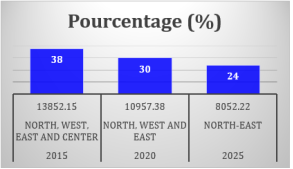
According to Table 1, in 2015, dry dense forests were still relatively continuous in the North, West, East, and part of the Center. From 2020, forest cover decline intensified in the central part, while the North and West remained the last concentrated forested areas. By 2025, the residual forest cover contracted significantly, persisting mainly in the Northeast, corresponding to more rugged and less accessible areas, less exposed to human exploitation.
Between 2015 and 2025, the forested area decreased by 5,799.93 ha, representing a relative loss of 42%. This corresponds to an average rate of 579 ha per year. This trend confirms a continuous dynamic of deforestation, consistent with regional observations .
Figure 3. Changes in forested areas between 2015 and 2025. Changes in forested areas between 2015 and 2025.
Table 2. Non-forested areas between 2015–2025. Non-forested areas between 2015–2025. Non-forested areas between 2015–2025.

Years

Area with Less Forest Cover

Non-forested Area (ha)

Pourcentage (%)

2015

South

22460.45

62

2020

South, Central, and East

25355.22

70

2025

North, West, and South

28260.36

78

Source: Deforestation evolution map (Figure 1)
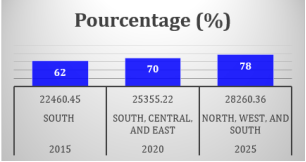
Next, Table 3 shows that non-forested areas already largely dominate the southern part as early as 2015. By 2020, non-forested areas extend toward the Central and Eastern regions, reflecting the expansion of agricultural conversion and pastoral fires. In 2025, non-forested areas also occupy the Northern and Western regions, indicating a widespread phenomenon. During this period, non-forested areas increased from 22,460 ha to 28,260 ha over ten years, representing a growth of 5,800 ha (+26%), corresponding to an average annual expansion of 580 ha per year, mirroring the loss of forest.
Figure 4. Changes in non-forested areas between 2015 and 2025. Changes in non-forested areas between 2015 and 2025.
4.1.2. Quantitative Changes in Forest Cover
Table 3. Observed changes in forest cover between 2015 and 2025. Observed changes in forest cover between 2015 and 2025. Observed changes in forest cover between 2015 and 2025.

Vegetation Cover

Forest area (ha)

Pourcentage (%)

Stable Forest

6236.07

17

Gain/ Reforestation

4721.31

13

Stable Non-forest

17739.14

49

Forest Loss

7616.09

21

Source: Deforestation evolution map (Figure 1)
According to Table 4, significant changes occurred between 2015 and 2025 in the Belindo-Mahasoa commune. The forest cover change data between 2015 and 2025 reveal four main trends.
1) Stable Forest (6,236 ha, 17%): Stable forest areas are primarily located in the northeastern part of Belindo-Mahasoa, where elevations range from approximately 480 m to 700 m. These sectors are characterized by moderately rugged terrain with hills and small mountains, including peaks such as 482 m, 548 m, and 692 m shown on the map. This topography makes access difficult for agricultural activities and logging, contributing to the preservation of forest cover. Additionally, the proximity of the Manambahy River, which flows through this area, enhances soil quality and water availability, creating favorable conditions for natural regeneration and forest resilience. Cultural protection through the concept of tany faly or ala faly—sacred areas where cutting is prohibited—also contributes to the stability and maintenance of forests in these sectors.
These forests provide essential habitats for numerous endemic and threatened species, such as Propithecus verreauxi (Verreaux’s sifaka) and Lemur catta (ring-tailed lemur). Xerophilous forests, although more widespread in peripheral areas, are also under threat and host emblematic species such as Pyxis arachnoides and Astrochelys radiata turtles. These forest formations thus represent a unique biodiversity reservoir and contribute to the conservation of threatened species. They also play an important role in above-ground carbon storage, aiding in the mitigation of greenhouse gas emissions .
2) Forest Gains / Reforestation (4,721 ha, 13%): Forest gains correspond to more isolated and difficult-to-access areas, often located near tributaries of the Manambahy River and in moderately to rugged terrain. These characteristics limit direct human pressures, favoring the success of reforestation programs conducted by the local community with support from the NGOs Tany Meva and AIM between 2022 and 2024. The availability of water resources and a topography unsuitable for intensive cultivation also contribute to faster regeneration.
3) Stable Non-forest (17,739 ha, 49%): This category corresponds to savannas and degraded areas, mainly located in the southern and western parts of the commune, where the terrain is generally flatter (around 300–400 m) and more accessible. This facilitates continued use for grazing, shifting cultivation, and bushfires. The low presence of topographical obstacles allows for more intensive and continuous exploitation of these areas.
4) Forest Loss (7,616 ha, 21%): Forest cover losses are concentrated around inhabited areas, along tracks, and in low-relief sectors where access is easier. These areas also correspond to intensive fuelwood collection, tavy (slash-and-burn agriculture) practices, and regions exposed to repeated fires. The combined impact of these socio-economic pressures is partly explained by the relatively flat topography and easy accessibility of these zones, contrasting with the natural protection of higher-elevation areas.
4.2. Factors of Deforestation in Belindo-Mahasoa
The results show that 100% of respondents observed a significant decline in forest cover over the past ten years, primarily in peripheral areas and plots accessible from villages. According to local residents, the main drivers of deforestation are wood harvesting for fuel and construction, agricultural expansion (tavy and subsistence crops), extensive livestock grazing, bushfires, and other causes (collection of medicinal plants, sand and gravel extraction, etc.). In the far south of Madagascar, including Bekily, rural livelihoods rely heavily on extensive agriculture (hatsake), often combined, where possible, with flood-recession cropping (Baiboho) .
4.2.1. Natural Factors: Climatic Hazards
The Belindo Mahasoa region, in the Bekily district (Androy region), is located in a semi-arid zone characterized by strong interannual variability in rainfall, high temperatures, and nearly constant desiccating winds, notably the Tiokatimo . According to an IRD report, Androy receives an average of 400 mm of rainfall per year, but this precipitation is poorly distributed throughout the year, and the average temperature is approximately 28 °C .
Between 2019 and 2021, southern Madagascar, including Androy, was severely affected by an extreme drought. The Global Drought Observatory reports that in November and December 2020, rainfall was below 50% of the long-term average . This consecutive drought was one of the most severe of the past decades and has been analyzed by researchers as an exceptionally intense event, linked to sea surface temperature (SST) anomalies in the Indian Ocean (e.g., negative SSTs south of Madagascar during the 2019–2020 rainy seasons reduced the influx of humid air over land) . These rainfall deficits, coupled with high temperatures, exert significant hydric stress on vegetation. Prolonged drought particularly affects the natural regeneration of dry dense forests: young seedlings struggle to survive, and deciduous species experience disrupted reproductive cycles, strongly reducing tree renewal rates . As a result, forest resilience is weakened.
4.2.2. Socio-Economic: Anthropogenic Pressures
In Belindo Mahasoa, human pressures represent the main driver of deforestation. Direct causes include wood harvesting for fuel and construction, agricultural expansion through slash-and-burn practices, and intentional fires used to clear fields, particularly between September and November, corresponding to the local agricultural calendar . These practices directly affect the structure and regeneration of dry dense forests by weakening young seedlings and disrupting the reproductive cycles of deciduous species. Indirect causes include population growth and poverty, which drive local communities to exploit forest resources for immediate needs. As highlights, extensive agriculture, wood harvesting, and demographic pressure exacerbate forest degradation, especially in semi-arid areas where climatic hazards (drought, heat) increase ecosystem vulnerability.
Field observations show that the most degraded areas are located near villages and cultivated lands, illustrating the link between human activity and deforestation. According to , “90% of the 982 tree species in dry forests are in decline,” reflecting the magnitude of the phenomenon in southern Madagascar. Quantitative data from the allow for measurement of this pressure: a household in Ambovombe consumes an average of 10.4 kg/person/month of charcoal, equivalent to 14,000 30-kg bags per month or 168,000 bags per year. Firewood consumption is estimated at 11,120 tons per year, with an average rate of 0.04 st/person/month. These figures, comparable to those in Belindo Mahasoa, demonstrate the extent of pressure on local forests, exploited for charcoal and timber supply to the city of Bekily.
Bushfires, often deliberately set, also contribute to the annual loss of 10,000 to 15,000 hectares in the Bekily area . This combination of human practices—wood harvesting, slash-and-burn agriculture, pastoralism, and intentional fires—systemically reduces the resilience of forests already weakened by drought and climatic variability . Thus, the socio-economic factor is not isolated; it interacts with natural constraints to accelerate deforestation and the degradation of forest ecosystems.
Table 4. Energy wood and charcoal consumption in the city of Ambovombe. Energy wood and charcoal consumption in the city of Ambovombe. Energy wood and charcoal consumption in the city of Ambovombe.

Type

Consumption per Household

Monthly Consumption

Annual Consumption

Charcoal

10,4 kg/person/month

14.000 bacs de 30 kg/month

168.000 bacs de 30kg/year

Firewood

0,04 st/person/monyh

--

11.120 tons/ year

Source: DREEFT Androy Monograph
4.3. Local Participatory Restoration Initiatives
In response to the progressive degradation of forests, the local community has developed participatory restoration initiatives with the support of the NGO Tany Meva and projects funded through the Cash for Work (CFW) mechanism. This initiative deserves recognition and support from other partners and the Malagasy government. These actions rely on the direct involvement of residents and the integration of local knowledge to ensure the sustainability of plantations and their adaptation to semi-arid conditions. Community mobilization, combined with the use of local knowledge and NGO support, represents a key lever for restoring degraded forests and strengthening the socio-ecological resilience of local populations .
The process begins with community dialogues aimed at raising awareness and mobilizing various local stakeholders, including traditional leaders, households, schools, and associations. These discussions help identify priority plots for planting, select suitable local species, and establish forest protection committees responsible for monitoring young plants. Between December 2023 and March 2024, four dialogue sessions were conducted, fostering community engagement and local responsibility in forest resource management.
Subsequently, local nurseries were established to produce seedlings. Community nurseries enable the local production of young plants adapted to the semi-arid climate. Water access, provided through wells and rivers, ensures the maintenance of seedlings during the long dry season. In Belindo-Mahasoa, two permanent nurseries have been established, capable of producing up to 25,000 seedlings per year, including species such as Eucalyptus citriodora, Acacia mangium, Mendoravia dumaziana, Schinus terebinthifolius, and Moringa oleifera. This local production reduces costs and ensures a continuous supply of seedlings.
The practical implementation relies on the CFW mechanism, which remunerates community participation and ensures regular maintenance of plantations. Residents are involved in plot preparation, planting, watering, and protection against livestock or fires. Technically, the community uses a hole-digging system of 40 × 40 × 40 cm, with spacing of 2.5 m × 2.5 m between plants, and basins to improve water retention. Windbreaks are installed to reduce wind erosion and enhance local microclimatic conditions. Agroforestry seedlings, including fruit and fodder species such as Mangifera indica and Moringa oleifera, as well as fuelwood species, are distributed to households. In December 2023, 8,000 seedlings were planted over 5 ha in the Ambasy fokontany. These plantations meet household food and energy needs without resorting to the cutting of dry forests. The involvement of schools and technical support for maintenance ensure the sustainability of these initiatives and strengthen the socio-ecological resilience of the community.
5. Conclusion
The study of deforestation dynamics in the Belindo Mahasoa commune highlights progressive degradation and significant fragmentation of deciduous dry dense forests and xerophilous forests. These ecosystems play a crucial role in endemic biodiversity conservation, carbon storage, and the regulation of local ecosystem services. Spatial analysis and field observations indicate that forest losses are particularly pronounced around inhabited areas and cultivated lands, emphasizing the importance of anthropogenic pressures, while semi-arid climatic conditions increase the vulnerability of young seedlings and hinder natural . Local participatory restoration initiatives, supported by NGOs and the mobilization of the fokonolona, are beginning to yield positive effects on certain plots, but their scale remains limited compared to the extent of deforestation. These findings demonstrate that sustainable conservation of dry forests in southern Madagascar requires an integrated approach combining ecological restoration, community management, and local awareness-raising.
The priority recommendations are as follows:
1) Strengthen participatory restoration by mobilizing traditional knowledge and increasing the area planted with native species.
2) Promote alternative energy sources to firewood, such as improved cookstoves or renewable energy, to reduce pressure on forests.
3) Encourage agroforestry and sustainable land management, combining crops with endemic trees to restore vegetation cover and improve soil fertility.
4) Implement regular forest monitoring through satellite imagery and community-based observations to quickly detect deforestation hotspots.
5) Raise awareness and train local communities on the importance of dry forests for biodiversity.
Abbreviations

AIM

Association Inter-cooperation of Madagascar

CFW

Cash for Work

DST

Department of Earth Sciences

ED GPCEHP

Thematic Doctoral School of Geosciences, Environmental Physics and Chemistry, and Host–Pathogen Systems

FAO

Food and Agriculture Organization

IRD

French Research Institute for Development

NDVI

Normalized Difference Vegetation Index

NGO

Non-Governmental Organization

PRD

Regional Development Plan

QGIS

Quantum Geographic Information System

RGPH3

General Census of Population and Housing 3rd edition

SST

Sea Surface Temperature

TAVY

Slash-and-Burn Agriculture

DREEFT

Regional Directorate of Water, Environment and Forests, Androy

Author Contributions
Tinahindraza Mampionona Albertin: Conceptualization, Data curation, Formal analysis, Investigation, Methodology, Writing – original draft
Tsiorisoa Harempahasoavana: Data curation, Visualization, Formal analysis
Romuald Ramanantsoavina: Writing – review & editing
Razakamanana Théodore: Formal analysis, Validation, Writing – review & editing
Conflicts of Interest
The authors declare no conflicts of interest.
References
[1] Virah-Sawmy, M. (2009). Ecosystem management in Madagascar during global change. Conservation Letters. 2(4): 163–170.
[2] Ministry of Water and Forests (1999). Report on Forest Degradation in Madagascar. Antananarivo, Madagascar.
[3] Tany Meva (2022). Local forestry statistics and population reports. Toliara, Madagascar.
[4] DREEFT Androy (2020). Monograph of Water and Forests, Androy Region. Toliara, Madagascar.
[5] Razafiarison, H., Rakotoarisoa, J., & Ravelomanana, T. (2003). Deforestation definition and impacts in Madagascar. Journal of Environmental Studies, 12: 45–56.
[6] Tany Meva (2024). Vegetation assessment and land cover change analysis in southern Madagascar. Toliara, Madagascar.
[7] RGPH3 (2018). General Census of Population and Housing, 3rd edition, Madagascar, Third General Census. Antananarivo, Madagascar.
[8] Riquier, et al. (1952). Vegetation and landscape of southwestern Madagascar.
[9] Harper, G. J., Steininger, M. K., Tucker, C. J., Juhn, D., & Hawkins, F. (2007). Fifty years of deforestation and forest fragmentation in Madagascar. Environmental Conservation, 34(4): 325–333.
[10] Asner, G. P., Clark, J. K., Mascaro, J., et al. (2012). Human and environmental controls over aboveground carbon storage in Madagascar. Carbon Balance and Management, 7: 2.
[11] Bidou, E., et al. (2009). Combined farming systems in southern Madagascar. Madagascar Journal of Agricultural Research, 15: 77–89.
[12] PRD Androy (2005). Regional Development Plan Androy. Toliara, Madagascar.
[13] IRD (2023). Climatic hazards and drought events in southern Madagascar. Institut de Recherche pour le Développement, Antananarivo, Madagascar.
[14] Copernicus Global Drought Observatory (GDO) (2021). Historical changes in drought and vegetation cover over Madagascar. Natural Hazards and Earth System Sciences, 25: 2939–2961.
[15] Weather & Climate Extremes (2022). Extreme drought analysis in southern Madagascar. Weather and Climate Extremes, 37: 101–115.
[16] Weather & Climate Extremes (2022). Extreme drought analysis in southern Madagascar – continued interpretation. Weather and Climate Extremes, 37: 101–115.
[17] Samb, S., et al. (2025). Agricultural practices and fires in Bekily, Madagascar. Journal of Local Ecology, 10: 200–215.
[18] Buttoud, G. (1995). Land use and forest degradation in semi-arid Madagascar. Journal of Sustainable Agriculture, 6: 23-40.
[19] Rakotovao, L. (2025). Species decline in southern Madagascar dry forests. Malagasy Biodiversity Journal, 8(1): 45–57.
[20] World Bank (2020). Madagascar partnership on deforestation reduction and carbon emissions. World Bank press release.
[21] Hervé, L. (2022). Forest regeneration challenges in southern Madagascar. Environmental Review, 20: 34–50.
Cite This Article
  • APA Style

    Albertin, T. M., Harempahasoavana, T., Ramanantsoavina, R., Théodore, R. (2026). Deforestation Dynamics and Ecological Consequences in the Dry Dense Deciduous Forests of Belindo-Mahasoa (Bekily, Southern Madagascar). American Journal of Environmental Protection, 15(1), 30-38. https://doi.org/10.11648/j.ajep.20261501.14

    Copy | Download

    ACS Style

    Albertin, T. M.; Harempahasoavana, T.; Ramanantsoavina, R.; Théodore, R. Deforestation Dynamics and Ecological Consequences in the Dry Dense Deciduous Forests of Belindo-Mahasoa (Bekily, Southern Madagascar). Am. J. Environ. Prot. 2026, 15(1), 30-38. doi: 10.11648/j.ajep.20261501.14

    Copy | Download

    AMA Style

    Albertin TM, Harempahasoavana T, Ramanantsoavina R, Théodore R. Deforestation Dynamics and Ecological Consequences in the Dry Dense Deciduous Forests of Belindo-Mahasoa (Bekily, Southern Madagascar). Am J Environ Prot. 2026;15(1):30-38. doi: 10.11648/j.ajep.20261501.14

    Copy | Download

  • @article{10.11648/j.ajep.20261501.14,
      author = {Tinahindraza Mampionona Albertin and Tsiorisoa Harempahasoavana and Romuald Ramanantsoavina and Razakamanana Théodore},
      title = {Deforestation Dynamics and Ecological Consequences in the Dry Dense Deciduous Forests of Belindo-Mahasoa (Bekily, Southern Madagascar)},
      journal = {American Journal of Environmental Protection},
      volume = {15},
      number = {1},
      pages = {30-38},
      doi = {10.11648/j.ajep.20261501.14},
      url = {https://doi.org/10.11648/j.ajep.20261501.14},
      eprint = {https://article.sciencepublishinggroup.com/pdf/10.11648.j.ajep.20261501.14},
      abstract = {The dry Dry deciduous forests in southern Madagascar are among the country’s most vulnerable ecosystems, increasingly threatened by expanding anthropogenic pressures., These forest formations are among the most heavily affected by deforestation, driven by agricultural expansion, charcoal production and timber extraction, leading to a continuous decline in forest cover. How have spatio-temporal deforestation dynamics between 2015 and 2025 altered forest cover, fragmentation, and ecological resilience in Belindo-Mahasoa, and what sustainable management responses are required to ensure long-term conservation efforts locally?. In the commune of Belindo-Mahasoa, located in the Bekily district, a spatio-temporal analysis of forest cover between 2015 and 2025 reveals a pronounced deforestation dynamic, marked by substantial reductions in wooded areas and increased landscape fragmentation. This pattern reflects a broader regional trend of rapid ecological degradation in southern Malagasy dry forests under increasing land-use pressures. Although small patches of vegetation recovery have emerged, largely linked to recent local restoration initiatives, their extent remains limited compared to the magnitude of forest loss. Overall, the findings underscore the urgent need to strengthen sustainable management strategies and restoration efforts to safeguard the essential ecological functions of these dry deciduous forests, whose resilience appears increasingly compromised. Thus, this article aims to provide recommendations to support conservation efforts and strengthen sustainable management strategies in order to safeguard the essential ecological functions of these dry deciduous forests.},
     year = {2026}
    }
    

    Copy | Download

  • TY  - JOUR
    T1  - Deforestation Dynamics and Ecological Consequences in the Dry Dense Deciduous Forests of Belindo-Mahasoa (Bekily, Southern Madagascar)
    AU  - Tinahindraza Mampionona Albertin
    AU  - Tsiorisoa Harempahasoavana
    AU  - Romuald Ramanantsoavina
    AU  - Razakamanana Théodore
    Y1  - 2026/01/31
    PY  - 2026
    N1  - https://doi.org/10.11648/j.ajep.20261501.14
    DO  - 10.11648/j.ajep.20261501.14
    T2  - American Journal of Environmental Protection
    JF  - American Journal of Environmental Protection
    JO  - American Journal of Environmental Protection
    SP  - 30
    EP  - 38
    PB  - Science Publishing Group
    SN  - 2328-5699
    UR  - https://doi.org/10.11648/j.ajep.20261501.14
    AB  - The dry Dry deciduous forests in southern Madagascar are among the country’s most vulnerable ecosystems, increasingly threatened by expanding anthropogenic pressures., These forest formations are among the most heavily affected by deforestation, driven by agricultural expansion, charcoal production and timber extraction, leading to a continuous decline in forest cover. How have spatio-temporal deforestation dynamics between 2015 and 2025 altered forest cover, fragmentation, and ecological resilience in Belindo-Mahasoa, and what sustainable management responses are required to ensure long-term conservation efforts locally?. In the commune of Belindo-Mahasoa, located in the Bekily district, a spatio-temporal analysis of forest cover between 2015 and 2025 reveals a pronounced deforestation dynamic, marked by substantial reductions in wooded areas and increased landscape fragmentation. This pattern reflects a broader regional trend of rapid ecological degradation in southern Malagasy dry forests under increasing land-use pressures. Although small patches of vegetation recovery have emerged, largely linked to recent local restoration initiatives, their extent remains limited compared to the magnitude of forest loss. Overall, the findings underscore the urgent need to strengthen sustainable management strategies and restoration efforts to safeguard the essential ecological functions of these dry deciduous forests, whose resilience appears increasingly compromised. Thus, this article aims to provide recommendations to support conservation efforts and strengthen sustainable management strategies in order to safeguard the essential ecological functions of these dry deciduous forests.
    VL  - 15
    IS  - 1
    ER  - 

    Copy | Download

Author Information
  • Graduate School of Geosciences (GPCEHP), University of Toliara, Toliara, Madagascar

  • Graduate School of Geosciences (GPCEHP), University of Toliara, Toliara, Madagascar

  • Graduate School of Geosciences (GPCEHP), University of Toliara, Toliara, Madagascar

  • Graduate School of Geosciences (GPCEHP), University of Toliara, Toliara, Madagascar;Department of Earth Sciences (DST), University of Toliara, Toliara, Madagascar

  • Abstract
  • Keywords
  • Document Sections

    1. 1. Introduction
    2. 2. Study Framework
    3. 3. Methodology
    4. 4. Results and Discussion
    5. 5. Conclusion
    Show Full Outline
  • Abbreviations
  • Author Contributions
  • Conflicts of Interest
  • References
  • Cite This Article
  • Author Information