
 ,
Younous Ali Ahmat*,
Mahamat Abdallah Ban-nah,
Boukar Abdelhakim,
Serigne Abdoul Aziz Niang,
Adoum Abdraman Mahamat
,
Younous Ali Ahmat*,
Mahamat Abdallah Ban-nah,
Boukar Abdelhakim,
Serigne Abdoul Aziz Niang,
Adoum Abdraman Mahamat
This study evaluates the biogas and methane production potential of three organic substrates, namely slaughterhouse waste, camel dung, and brewery waste (brewers’ spent grain), to assess their suitability for anaerobic digestion and renewable energy production. The evaluation was based on the physicochemical characterization of the substrates, including organic matter content and carbon-to-nitrogen (C/N) ratio, which are recognized as key factors influencing microbial activity, process stability, and methane generation. Fresh samples were analyzed using standardized laboratory methods to estimate theoretical biogas potential together with expected biogas and methane yields. Results show that physicochemical composition strongly affects methanogenic performance. Camel dung exhibited high organic matter content and a favorable C/N ratio (20.2), resulting in a methane yield of 111 Nm³ CH₄/t FM and good process stability. Its balanced nutrient composition provides favorable conditions for methanogenic microorganisms, promoting efficient organic matter degradation and stable methane production. These characteristics identify camel dung as the most suitable substrate for anaerobic digestion among those investigated. In contrast, brewery waste showed the highest theoretical biogas potential (650 LN/kg OM) due to its high biodegradable organic matter content. However, its low C/N ratio (5.4) increased the risk of ammonia inhibition, limiting methane yield to 75 Nm³ CH₄/t FM despite its considerable energy potential. This finding demonstrates that a high theoretical biogas potential does not necessarily result in high methane production when nutrient balance is unfavorable for microbial metabolism. Although slaughterhouse waste had an optimal C/N ratio (23.3), it produced the lowest methane yield (32 Nm³ CH₄/t FM), suggesting lower biodegradability. This reduced performance may be associated with the presence of protein- and lipid-rich compounds capable of generating inhibitory intermediates that negatively affect methanogenic activity and methane conversion efficiency. Overall, camel dung appeared to be the most balanced substrate, while spent grain represents a promising energy-rich co-substrate and slaughterhouse waste a complementary feedstock for co-digestion. Their complementary characteristics suggest that co-digestion could optimize the C/N ratio, improve process stability, and enhance methane production. Analyses were conducted at the Biogaz PlanET France laboratory.
| Published in | American Journal of Environmental Protection (Volume 15, Issue 4) |
| DOI | 10.11648/j.ajep.20261504.14 |
| Page(s) | 140-147 |
| Creative Commons |
This is an Open Access article, distributed under the terms of the Creative Commons Attribution 4.0 International License (http://creativecommons.org/licenses/by/4.0/), which permits unrestricted use, distribution and reproduction in any medium or format, provided the original work is properly cited. |
| Copyright |
Copyright © The Author(s), 2026. Published by Science Publishing Group |
Anaerobic Digestion, Methane Production, Organic Substrates, Carbon-to-nitrogen (C/N) Ratio, Co-digestion
Substrates | Organic Carbon (C) | Total Nitrogen (N) | C /N Ratio |
|---|---|---|---|
Sample 1 | 7 | 0,3 | 23,3 |
Sample 2 | 27,3 | 1,35 | 20,2 |
Sample 3 | 11,4 | 2,11 | 5,40 |
FM | Fresh Matter |
DM | Dry Matter |
OM | Organic Matter |
| [1] | A. Saidi-Bulahia, S. Abada, M. Saber. Valorization of household organic waste and bovine waste through methanization, 2018 J. Ren. Energies, vol. 21, no. 4, pp. 537-543, |
| [2] | Angelidaki I, Karakashev D, Batstone D J, Plugge C M, Stams A J M. Biomethanation and its potential. 2011, volume (494), 327-351. |
| [3] | Patterson, T.; Esteves, S.; Dinsdale, R.; Guwy, A. An evaluation of the policy and techno-economic factors affecting the potential for biogas upgrading for transport fuel use in the UK. 2011, Energy Policy, 39, 1806-1816. |
| [4] | Chew, K. R.; Leong, H. Y.; Khoo, K. S.; Vo, D.-V. N.; Anjum, H.; Chang, C.-K.; Show, P. L. Effects of anaerobic digestion of food waste on biogas production and environmental impacts: A review. Environ. Chem. 2021, Lett, 19, 2921-2939. |
| [5] | Hu J, Stenchly K, Gwenzi W, Wachendorf M and Kaetzl K. Critical evaluation of biochar effects on methane production and process stability in anaerobic digestion. 2023 Sec. Bioenergy and Biofuels, |
| [6] | Chen Y., Cheng J. J., Creamer K. S. Inhibition of anaerobic digestion process: A review. 2008, Bioresource Technology, 99(10), 4044-4064. |
| [7] | Song, Y.; Qiao, W.; Westerholm, M.; Huang, G.; Taherzadeh, M. J.; Dong, R. Microbiological and Technological Insights on Anaerobic Digestion of Animal Manure: review. 2023, Fermentation, 9(5), 436. |
| [8] | Sakar, S.; Yetilmezsoy, K.; Kocak, E. Anaerobic digestion technology in poultry and livestock waste treatment—A literature review. 2009, Waste Manag. Res, 27, 3-18. |
| [9] | Zubair, M.; Wang, S.; Zhang, P.; Ye, J.; Cai, Y (2020). Biological nutrient removal and recovery from solid and liquid livestock manure: Recent advance and perspective. 2020, Bioresour. Technol., 301, 122823. |
| [10] | Cabrita T M and Santos M T, Biochemical Methane Potential Assays for Organic Wastes as an Anaerobic Digestion Feedstock. 2023, Sustainability, 15(15), 11573; |
| [11] | Neri, A.; Bernardi, B.; Zimbalatti, G.; Benalia, S. An Overview of Anaerobic Digestion of Agricultural By-Products and Food Waste for Biomethane Production. 2023, Energies, 16(19), 6851. |
| [12] | Rodolfo Llanos-Lizcano, Lacrimioara Senila and Oana Cristina Modoi. Evaluation of Biochemical Methane Potential and Kinetics of Organic Waste Streams for Enhanced Biogas Production. 2024, Agronomy, 14(11), 2546. |
| [13] | Parvez K and Ahammed M M. Effect of composition on anaerobic digestion of organic fraction of municipal solid wastes: A review. 2024, Bioresource Technology Reports. |
| [14] | Pradeshwaran V, Sundaramoorthy V and Saravanakumar A. A comprehensive review on biogas production from food waste: Exploring cutting-edge technologies and innovations. 2024, Biomass and Bioenergy. |
| [15] | Aworanti OA, Ajani AO, Agbede OO, Agarry SE, Ogunkunle O, Laseinde OT, Kalam MA and Fattah IMR. Enhancing and upgrading biogas and biomethane production in anaerobic digestion: a comprehensive review. 2023 Front. Energy Res. 11: 1170133. |
| [16] | González, R.; Peña, D. C.; Gómez, X. Anaerobic Co-Digestion of Wastes: Reviewing Current Status and Approaches for Enhancing Biogas Production. 2022, Appl. Sci., 12, 8884. |
| [17] | Di Mario, J., Bertoldi, A., Priolo, D., Calzoni, E., Gambelli, A. M., Dominici, F., Rallini, M., Del Buono, D., Puglia, D., Emiliani, C., & Gigliotti, G. Characterization of Processes Aimed at Maximizing the Reuse of Brewery’s Spent Grain: Novel Biocomposite Materials, High-Added-Value Molecule Extraction, Codigestion and Composting. 2025 Recycling, 10, 124. |
| [18] | Nyhan L, Salim A W, Schmitz H H, Siegel J B, Arendt E K. Brewers’ Spent Grain: An Unprecedented Opportunity to Develop Sustainable Plant-Based Nutrition Ingredients Addressing Global Malnutrition Challenges. 2023, Journal of Agricultural and Food Chemistry, |
| [19] | Zhao, C.; Yang, L.; Li, H.; Deng, Z. Nitrogen Metabolism during Anaerobic Fermentation of Actual Food Waste under Different pH Conditions. 2024, Fermentation, 10, 129. |
| [20] | Bharadwaj, A., Holwerda, E. K., Regan, J. M. et al. Enhancing anaerobic digestion of lignocellulosic biomass by mechanical cotreatment. 2024, Biotechnol Biofuels volume (17), 76. |
| [21] | Adnane I, Taoumi H, Elouahabi K, Lahrech K, Oulmekki A. Valorization of crop residues and animal wastes: Anaerobic co-digestion technology. 2025, Heliyon, 10(5): e26440. |
| [22] | Guo Z, Usman M, Alsareii S, Harraz F, Al-Assiri M S, Jalalah M, Li X, Salama E. Synergistic ammonia and fatty acids inhibition of microbial communities during slaughterhouse waste digestion for biogas production. 2021, Bioresource Technology, |
| [23] | Yang, Z., Larsen, O. C., Muhayodin, F. et al. Review of anaerobic digestion models for organic solid waste treatment with a focus on the fates of C, N, and P. 2025, Energ. Ecol. Environ. 10, 1-14. |
| [24] | Xiao Y, Mackey H R, and al. Disentangling microbial niche balance and intermediates’ trade-offs for anaerobic digestion stability and regulation. 2024 Water Research. |
| [25] | Chen J, Sun Yand Chen H. Enhancing methane production in anaerobic digestion of waste activated sludge by combined thermal hydrolysis and photocatalysis pretreatment. 2024, Bioresource Technology, |
| [26] | Bühlmann CH, Astals S, Mickan BS, McCabe BK, Tait S. Adsorption-style rate kinetics best describes long chain fatty acid inhibition of methanogenesis. 2026, Bioresour Technol. |
| [27] | Sayara, T.; Sánchez, A. A Review on Anaerobic Digestion of Lignocellulosic Wastes: Pretreatments and Operational Conditions. 2019, Appl. Sci, 9, 4655. |
APA Style
Al-hafiz, A. A., Ahmat, Y. A., Ban-nah, M. A., Abdelhakim, B., Niang, S. A. A., et al. (2026). Physicochemical Characterization and Biogas Potential assessment of Three Organic Substrates. American Journal of Environmental Protection, 15(4), 140-147. https://doi.org/10.11648/j.ajep.20261504.14
ACS Style
Al-hafiz, A. A.; Ahmat, Y. A.; Ban-nah, M. A.; Abdelhakim, B.; Niang, S. A. A., et al. Physicochemical Characterization and Biogas Potential assessment of Three Organic Substrates. Am. J. Environ. Prot. 2026, 15(4), 140-147. doi: 10.11648/j.ajep.20261504.14
AMA Style
Al-hafiz AA, Ahmat YA, Ban-nah MA, Abdelhakim B, Niang SAA, et al. Physicochemical Characterization and Biogas Potential assessment of Three Organic Substrates. Am J Environ Prot. 2026;15(4):140-147. doi: 10.11648/j.ajep.20261504.14
@article{10.11648/j.ajep.20261504.14,
  author = {Abdoulaye Affadine Al-hafiz and Younous Ali Ahmat and Mahamat Abdallah Ban-nah and Boukar Abdelhakim and Serigne Abdoul Aziz Niang and Adoum Abdraman Mahamat},
  title = {Physicochemical Characterization and Biogas Potential assessment of Three Organic Substrates},
  journal = {American Journal of Environmental Protection},
  volume = {15},
  number = {4},
  pages = {140-147},
  doi = {10.11648/j.ajep.20261504.14},
  url = {https://doi.org/10.11648/j.ajep.20261504.14},
  eprint = {https://article.sciencepublishinggroup.com/pdf/10.11648.j.ajep.20261504.14},
  abstract = {This study evaluates the biogas and methane production potential of three organic substrates, namely slaughterhouse waste, camel dung, and brewery waste (brewers’ spent grain), to assess their suitability for anaerobic digestion and renewable energy production. The evaluation was based on the physicochemical characterization of the substrates, including organic matter content and carbon-to-nitrogen (C/N) ratio, which are recognized as key factors influencing microbial activity, process stability, and methane generation. Fresh samples were analyzed using standardized laboratory methods to estimate theoretical biogas potential together with expected biogas and methane yields. Results show that physicochemical composition strongly affects methanogenic performance. Camel dung exhibited high organic matter content and a favorable C/N ratio (20.2), resulting in a methane yield of 111 Nm³ CH₄/t FM and good process stability. Its balanced nutrient composition provides favorable conditions for methanogenic microorganisms, promoting efficient organic matter degradation and stable methane production. These characteristics identify camel dung as the most suitable substrate for anaerobic digestion among those investigated. In contrast, brewery waste showed the highest theoretical biogas potential (650 LN/kg OM) due to its high biodegradable organic matter content. However, its low C/N ratio (5.4) increased the risk of ammonia inhibition, limiting methane yield to 75 Nm³ CH₄/t FM despite its considerable energy potential. This finding demonstrates that a high theoretical biogas potential does not necessarily result in high methane production when nutrient balance is unfavorable for microbial metabolism. Although slaughterhouse waste had an optimal C/N ratio (23.3), it produced the lowest methane yield (32 Nm³ CH₄/t FM), suggesting lower biodegradability. This reduced performance may be associated with the presence of protein- and lipid-rich compounds capable of generating inhibitory intermediates that negatively affect methanogenic activity and methane conversion efficiency. Overall, camel dung appeared to be the most balanced substrate, while spent grain represents a promising energy-rich co-substrate and slaughterhouse waste a complementary feedstock for co-digestion. Their complementary characteristics suggest that co-digestion could optimize the C/N ratio, improve process stability, and enhance methane production. Analyses were conducted at the Biogaz PlanET France laboratory.},
 year = {2026}
}
TY  - JOUR
T1  - Physicochemical Characterization and Biogas Potential assessment of Three Organic Substrates
AU  - Abdoulaye Affadine Al-hafiz
AU  - Younous Ali Ahmat
AU  - Mahamat Abdallah Ban-nah
AU  - Boukar Abdelhakim
AU  - Serigne Abdoul Aziz Niang
AU  - Adoum Abdraman Mahamat
Y1  - 2026/08/24
PY  - 2026
N1  - https://doi.org/10.11648/j.ajep.20261504.14
DO  - 10.11648/j.ajep.20261504.14
T2  - American Journal of Environmental Protection
JF  - American Journal of Environmental Protection
JO  - American Journal of Environmental Protection
SP  - 140
EP  - 147
PB  - Science Publishing Group
SN  - 2328-5699
UR  - https://doi.org/10.11648/j.ajep.20261504.14
AB  - This study evaluates the biogas and methane production potential of three organic substrates, namely slaughterhouse waste, camel dung, and brewery waste (brewers’ spent grain), to assess their suitability for anaerobic digestion and renewable energy production. The evaluation was based on the physicochemical characterization of the substrates, including organic matter content and carbon-to-nitrogen (C/N) ratio, which are recognized as key factors influencing microbial activity, process stability, and methane generation. Fresh samples were analyzed using standardized laboratory methods to estimate theoretical biogas potential together with expected biogas and methane yields. Results show that physicochemical composition strongly affects methanogenic performance. Camel dung exhibited high organic matter content and a favorable C/N ratio (20.2), resulting in a methane yield of 111 Nm³ CH₄/t FM and good process stability. Its balanced nutrient composition provides favorable conditions for methanogenic microorganisms, promoting efficient organic matter degradation and stable methane production. These characteristics identify camel dung as the most suitable substrate for anaerobic digestion among those investigated. In contrast, brewery waste showed the highest theoretical biogas potential (650 LN/kg OM) due to its high biodegradable organic matter content. However, its low C/N ratio (5.4) increased the risk of ammonia inhibition, limiting methane yield to 75 Nm³ CH₄/t FM despite its considerable energy potential. This finding demonstrates that a high theoretical biogas potential does not necessarily result in high methane production when nutrient balance is unfavorable for microbial metabolism. Although slaughterhouse waste had an optimal C/N ratio (23.3), it produced the lowest methane yield (32 Nm³ CH₄/t FM), suggesting lower biodegradability. This reduced performance may be associated with the presence of protein- and lipid-rich compounds capable of generating inhibitory intermediates that negatively affect methanogenic activity and methane conversion efficiency. Overall, camel dung appeared to be the most balanced substrate, while spent grain represents a promising energy-rich co-substrate and slaughterhouse waste a complementary feedstock for co-digestion. Their complementary characteristics suggest that co-digestion could optimize the C/N ratio, improve process stability, and enhance methane production. Analyses were conducted at the Biogaz PlanET France laboratory.
VL  - 15
IS  - 4
ER  -
Department of Technology, University of N’Djamena, N’Djamena, Chad
Biography: Abdoulaye Affadine Al-hafiz is a Ph.D. candidate in the Department of Technology, Faculty of Exact and Applied Sciences, University of N’Djamena, Chad. He holds a Master’s degree in Mechanical Engineering from the University Institute of Science and Technology of Abéché (IUSTA). He is also a Hydrocarbon Inspector at the Ministry of Petroleum, Mines and Geology of Chad. His research interests include renewable energy, waste-to-energy conversion, anaerobic digestion, and biogas production from organic waste, with a focus on sustainable energy solutions adapted to the Chadian context.
Research Fields: Biogas, Biomass, Chemistry, Energy, Climate, Bioenergy

Department of Physics, Cheikh Anta Diop University of Dakar, Dakar, Senegal
Biography: Younous Ali Ahmat is a Ph.D. candidate in Energy and Climate in the Department of Physics at Cheikh Anta Diop University (UCAD), Dakar, Senegal. He holds a Master’s degree in Renewable Energy from the University of Ngaoundéré, Cameroon. His research focuses on renewable energy systems, atmospheric sciences, aerosols, and climate–energy interactions. He is particularly interested in biomass energy and biogas production, including the physicochemical characterization of organic substrates, biomethane potential assessment, and anaerobic digestion. His work aims to develop sustainable energy solutions adapted to local conditions and contribute to waste valorization, clean energy production, and Africa’s energy transition.
Research Fields: Energy, Climate, Biomass, Bioenergy, Aerosol

Department of Mechanical Engineering, National Higher Institute of Science and Technology of Abeche, Abeche, Chad
Biography: Mahamat Abdallah Ban-nah is a CAMES Assistant Professor and Head of the Department of Mechanical Engineering at the National Higher Institute of Sciences and Technology of Abéché (INSTA), Chad. His teaching and research activities focus on mechanical engineering, thermal systems, renewable energy, and energy technologies. His research interests include biomass valorisation, biogas production, energy efficiency, and the design and optimization of sustainable technologies adapted to Sahelian conditions. He has contributed to scientific research projects and publications promoting renewable energy development, technological innovation, and sustainable use of local resources in Chad.
Research Fields: Mechanic, Energy, Bioenergy, Climate, Chemistry

Department of Technology, University of N’Djamena, N’Djamena, Chad
Biography: Boukar Abdelhakim is a Professor in the Department of Physics at the University of N’Djamena, Chad, and Director of the Doctoral School of Science, Technology and Environment. He received his Ph.D. in Engineering Sciences from Université Savoie Mont Blanc, France, in 2014. His research focuses on renewable energy, energy conversion, environmental sciences, biogas production, and anaerobic digestion. He has published in international peer-reviewed journals and supervised Master’s and Ph.D. students. His work contributes to developing sustainable energy solutions adapted to local conditions.
Research Fields: Mechanic, Energy, Biomass, Bioenergy, Chemical Process Engineering

Department of Physics, Cheikh Anta Diop University of Dakar, Dakar, Senegal
Biography: Serigne Abdoul Aziz Niang received his Ph.D. in Applied Physics, specializing in Renewable Energy and Energy Transition, from Cheikh Anta Diop University, Senegal, in 2026. His research interests include renewable energy systems, photovoltaic and wind energy, energy transition, climate–energy interactions, atmospheric aerosols, and sustainable energy planning. He is also interested in biomass energy and biogas production from organic substrates, particularly their physicochemical characterization and biomethane potential. He has authored and co-authored peer-reviewed scientific publications and contributes to renewable energy and climate research in Africa.
Research Fields: Energy, Climate, Biomass, Bioenergy, Aerosol

Department of Technology, University of N’Djamena, N’Djamena, Chad
Biography: Adoum Abdraman Mahamat is a CAMES Associate Professor in Energy Engineering at the Department of Physics, University of N’Djamena, Chad. He received his Ph.D. in Applied Physics and Engineering, specializing in Energy and Thermal Processes, from the University of Ngaoundéré, Cameroon, in 2019. His research interests include renewable energy, thermal processes, energy efficiency, biomass valorisation, and biogas production. His current work focuses on the physicochemical characterization of organic substrates and their biomethane potential for anaerobic digestion. He has contributed to national and international research projects and scientific publications.
Research Fields: fluid mechanics, Energy, Climate, Bioenergy, Chemical Process Engineering

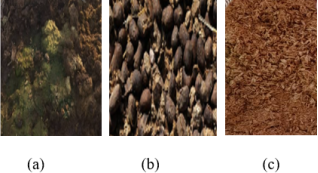
Figure 1. (a) Slaughterhouse waste, (b) Camel dung, and (c) Brewery waste (brewers’ spent grain).
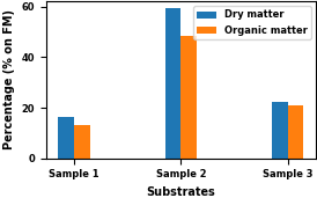
Figure 2. Distribution of dry matter and organic matter content in the substrates: slaughterhouse waste (Sample 1), camel dung (Sample 2), and brewer’s spent grain (Sample 3).
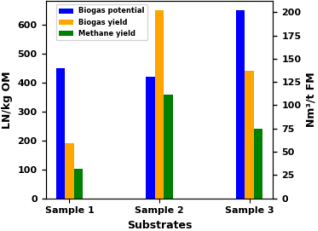
Figure 3. Comparison of the biogas potential (blue), biogas yield (orange), and methane yield (green) of the three substrates.

Information


 Share This Article
 Twitter
 Linked In
 Facebook
 Copy
Copy Download